


A client sends an urgent message about a campaign issue. Your team is busy managing deadlines, meetings, and multiple accounts. By the time someone answers, the client has already begun to question whether their project is getting enough attention. For agencies, this is why digital agency client communication has become a top priority. Today’s customers need prompt responses, lucid updates, and dependable assistance without having to wait hours for a response.
Today’s clients want more than simply scheduled meetings and occasional email updates. They expect prompt responses, up-to-date project details, and simple communication across multiple platforms. Customers value businesses that are simple to reach and responsive, whether they are checking on the status of a campaign, asking for changes, or needing assistance.
For example, an agency managing SEO, paid ads, and website projects may receive dozens of questions each week:
“Are the landing page changes live?”
“When will the campaign report be ready?”
“Can we update this offer before Monday?”
Handling every request manually can quickly consume valuable team hours.
This is where artificial intelligence is helping agencies improve the way they interact with clients. Artificial intelligence (AI)-driven consumer communication systems are capable of managing standard discussions, responding instantly, and providing assistance outside of regular business hours. These solutions help agencies meet increasing communication needs while preserving a more effective and customized client experience.
The future of client communication in digital agencies will rely on striking the correct balance between technology and interpersonal relationships. By using AI to enhance meaningful interactions rather than replace them, a customer support agency can strengthen client relationships, improve operational efficiency, and create a solid foundation for long-term growth and success.
Why Client Communication Is Changing for Digital Agencies
A few years ago, most clients were comfortable waiting until the next day for an email response. Today, expectations have changed significantly.
People are accustomed to having rapid access to information these days. They can make online service reservations without long conversations, track delivery in real time, and speak with companies in seconds. As a result of these experiences, clients now expect the same speed and simplicity when dealing with digital firms.
Delays in responding to client inquiries about campaign performance, project updates, or plan clarification can lead to frustration. Nowadays, quick communication is more than simply practical. It now plays a significant role in the entire customer experience.
Clients want timely responses and transparent updates throughout a project. When agencies take too long to respond, clients may feel alienated or undervalued, which can damage long-term relationships, satisfaction, and trust.
Traditional communication methods like email are still helpful, especially for comprehensive updates and documentation. But relying solely on email can hinder collaboration, particularly when multiple team members or stakeholders are involved. Faster communication channels allow agencies to respond to questions more quickly, reduce delays, and foster more engaging client interactions.
Communication needs are also evolving as digital services become more complicated. SEO campaigns, paid advertising, website development, social media tactics, and content marketing initiatives are just a few of the many areas that agencies now frequently oversee. Clients demand simpler access to support when they need it and better visibility into progress because there are so many moving elements.
As digital agencies expand, it becomes harder to stay in constant, responsive contact with clients. To handle numerous transactions, monitor updates, and guarantee that every client receives prompt service, a more organized approach is required.
This shift has led many organizations to explore smarter communication techniques that allow teams to respond faster, improve client experiences, and build closer bonds without adding more work.
Why Digital Agencies Are Rethinking Client Communication
Artificial intelligence is changing how agencies communicate with prospects and clients. Instead of handling every interaction manually, agencies can use AI-powered tools to support faster, more efficient communication throughout the customer journey.
AI Live Chat
AI live chat technology has grown in popularity as an agency communication tool. Instead of waiting for a response through conventional contact forms, it enables website users to identify pertinent services, get support, and get immediate answers.
Speed matters even before a conversation starts. Google’s research found that as mobile page load time goes from one to ten seconds, the likelihood of a visitor leaving increases by 123%. The same impatience applies to communication: if a prospect can’t get a fast answer once they’re on the site, they’re just as likely to bounce.
For agencies focused on growth, this approach can significantly improve lead capture opportunities. Businesses that implement live chat services to boost leads often see higher engagement levels because potential clients receive answers when their interest is highest.
In fact, many agencies use AI-driven chat tools to boost customer engagement using live chat, creating meaningful interactions that keep prospects engaged and moving through the sales funnel. Instead of leaving a website without taking action, visitors can begin conversations instantly and receive the information they need.
AI is crucial for lead qualification as well. AI systems can collect data, determine customer needs, and direct conversations to the relevant department, saving team members from having to manually evaluate each inquiry. This increases productivity and simplifies processes.
AI Voice Agents
Voice-based AI technology is also opening new communication opportunities for agencies. AI voice agents can answer calls, schedule consultations, share information, and handle follow-ups, helping agencies stay connected even when team members are unavailable.
As AI continues to advance, agencies are using automation to support their communication strategies. The goal is not to replace human interaction but to reduce repetitive tasks and ensure clients receive timely support.
How AI Fits Into an Agency’s Daily Client Conversations
Digital agencies may improve the customer experience by offering more personalized interactions, quicker responses, and consistent assistance thanks to AI. A satisfying customer experience is essential for developing trust, boosting retention, and creating long-lasting relationships. Effective communicators are more likely to maintain client satisfaction and encourage referrals.
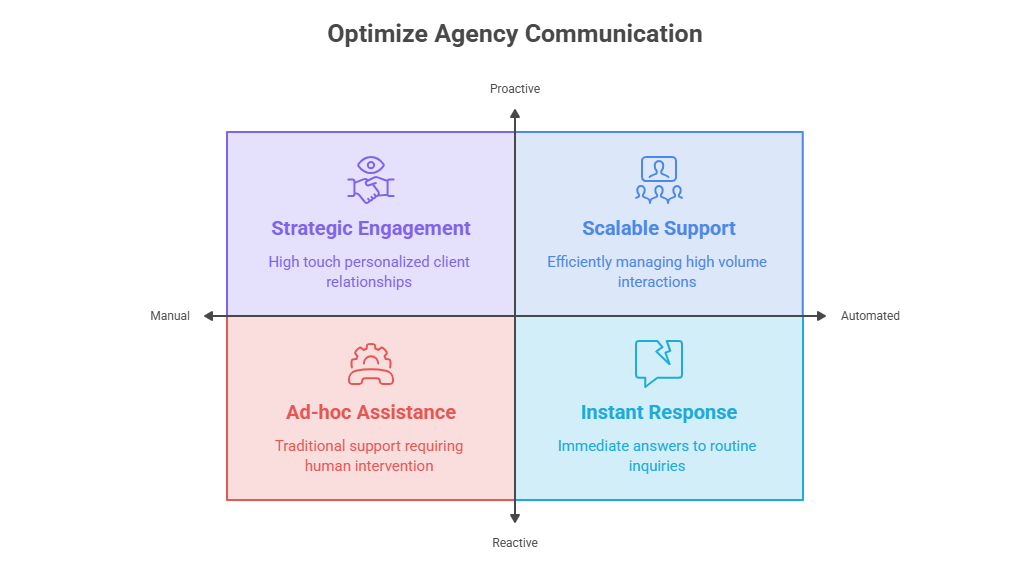
One of AI’s key advantages is its ability to respond faster. Consumers no longer have to wait hours or days to hear back. AI-enabled chat systems can interact with customers quickly, improving responsiveness and overall experience.
Another major advantage is availability. Modern businesses operate in a global marketplace, and clients may need support outside traditional working hours. Through client 24/7 chat support for businesses, agencies can remain accessible regardless of time zone differences or office schedules.
This constant availability helps improve customer satisfaction by ensuring inquiries are acknowledged and handled quickly. AI can answer questions, collect crucial information, and carry on conversations even when a team member is not there.
By managing routine communication chores like appointment reminders, onboarding messages, status updates, and frequently asked questions, AI also simplifies client administration. Agency staff can concentrate on more crucial tasks as a result of the time savings.
Scalability is another important advantage. Communication demands rise when agencies expand and take on new clients. AI technologies help handle increased conversation volumes without lowering service quality or requiring a sizable support staff.
Businesses that use live chat for digital agencies often find that automation helps them maintain consistent communication standards while supporting continued growth. Clients benefit from faster service, and agencies benefit from greater operational efficiency.
Communication Trends That Will Shape Agency Relationships
The future of digital agency communication will focus on AI automation, personalized experiences, and faster customer interactions.
Technology continues to evolve, and communication strategies will evolve alongside it.
AI-Powered Personalization
Future communication systems will analyze customer behaviors and preferences to create highly personalized interactions. Benefits include:
- More relevant recommendations
- Customized support experiences
- Increased customer satisfaction
- Improved retention rates
Voice-First Customer Experiences
Voice interactions are becoming increasingly popular. Many customers prefer speaking rather than typing, especially when dealing with complex inquiries. AI voice technology will continue improving conversational quality and accessibility.
Omnichannel Communication
Customers expect consistent experiences across:
- Websites
- Phone calls
- Social media
- Messaging platforms
Modern communication solutions will unify these channels into a seamless communication ecosystem.
Human and AI Collaboration
AI will not replace human teams. Instead, it will support them. The most successful agencies will combine:
- Human creativity
- Strategic expertise
- Relationship management
- AI-powered automation
This collaboration creates stronger customer experiences while improving efficiency.
Predictive Customer Support
Future AI systems will anticipate customer needs before problems arise. Predictive support may include:
- Automated reminders
- Proactive issue resolution
- Personalized recommendations
- Customer behavior insights
These capabilities will help agencies strengthen client relationships while reducing support burdens. According to Salesforce research, customers increasingly expect businesses to understand their needs and provide proactive support experiences.
AI Chat and Voice Support vs Traditional Client Support
AI support improves traditional customer service by reducing response delays and automating repetitive conversations.
While traditional communication methods remain valuable, they often struggle to meet modern client expectations. AI-powered communication tools address many of these limitations by providing immediate assistance and continuous availability. This shift reflects where the broader market is heading. Gartner predicts that by 2028, at least 70% of customers will use a conversational AI interface to start their customer service journey.
| Traditional Support | AI-Powered Support |
| Limited working hours | 24/7 availability |
| Manual responses | Automated replies |
| Slower response times | Live chat support services |
| Limited conversation capacity | Handles multiple conversations simultaneously |
| Higher staffing requirements | Greater operational efficiency |
| Reactive communication | Proactive engagement |
Traditional support teams often spend considerable time answering repetitive questions. While
These interactions are necessary; they can divert attention from strategic work that requires human expertise.
A chatbot can handle simple questions like pricing, availability, or service details. When a client needs strategic advice or has a complicated issue, the conversation can be transferred to a real person. This creates a balanced approach where technology enhances service quality without eliminating human involvement.
As client expectations continue to rise, many agencies view AI as an essential component of future-ready digital agency client communication strategies.
How Live Chat Squad Helps Agencies Build Better Client Communication
Effective communication requires the right technology, strategy, and support infrastructure.
Digital agencies can use Live Chat Squad to create a smoother communication experience for their clients. Our AI chat and call solutions help businesses provide reliable support at every stage of the customer journey.
Live Chat Squad helps agencies:
- Automate customer conversations
- Provide AI-powered chat support
- Manage AI-driven voice interactions
- Improve response times
- Increase lead capture opportunities
- Deliver scalable customer support solutions
Whether agencies need website chat support, lead qualification, or advanced automation tools, Live Chat Squad offers solutions designed to support growth and customer engagement.
Agencies can also learn more about boosting customer engagement using live chat to strengthen relationships and improve conversion rates.
Additionally, organizations seeking comprehensive communication support can explore Live Chat Squad’s full range of AI-powered customer support solutions available through the company’s homepage.
Building the Next Generation of Client Relationships
Businesses that integrate AI technology with customized consumer experiences will own the future of client communication.
As consumers seek quicker, more comfortable, and more individualized encounters, expectations about digital agency client communication will continue to change. Adopting AI-powered communication solutions can help agencies satisfy these demands and promote sustainable growth.
AI chat systems, voice agents, automated processes, and predictive support are just a few examples of how contemporary communication technology is helping organizations forge closer bonds and increase operational effectiveness. These solutions help companies stay competitive, scalable, and responsive in a market that is becoming increasingly digital.
Live Chat Squad assists organizations in need of dependable methods for handling incoming chats without placing additional strain on their internal workforce. The objective is straightforward: assist agencies in responding more quickly while retaining human knowledge where it counts most, from online inquiries to lead qualifying.
Ready to boost your agency’s client communication? Get in touch with Live Chat Squad right now to see how AI-powered assistance can improve connections, automate interactions, and support the expansion of your agency.
Frequently Asked Questions
How Does AI Improve Digital Agency Client Communication?
AI improves digital agency client communication by providing instant responses, automating repetitive tasks, personalizing interactions, and ensuring clients receive support whenever they need assistance.
Why Is Fast Communication Important for Agencies?
Fast communication helps agencies build trust, improve client satisfaction, resolve issues more efficiently, and strengthen long-term business relationships.
Can AI Provide 24/7 Customer Support?
Yes. AI-powered chat and voice solutions can engage visitors, answer common questions, qualify leads, and provide support at any time of day or night.
What Are Customer Communication Solutions?
Customer communication solutions are tools and technologies that help businesses manage conversations across channels such as live chat, phone, email, social media, and messaging platforms.
How Does Live Chat Help Digital Agencies?
Live chat helps digital agencies engage website visitors instantly, answer questions in real time, improve lead generation efforts, and create a better overall customer experience.
Will AI Replace Human Customer Support Teams?
No. AI is designed to support human teams by automating routine tasks, while employees focus on complex inquiries, relationship management, and strategic decision-making.
What Communication Trends Should Agencies Watch?
Agencies should focus on AI-powered personalization, voice-first interactions, omnichannel communication, predictive customer support, and the growing collaboration between human teams and AI technologies.