


The caller has explained the billing error twice. Your voice agent sounds calm, then repeats, ‘I understand your frustration’, and offers the same answer again. The customer hangs up, still charged incorrectly. In their mind, your business just stopped listening.
An AI voice agent listens to callers, interprets their requests, and speaks replies using business-provided information and rules. In customer service, AI handling angry customers means recognizing the problem, responding within defined limits, and transferring the call when a person needs to take over. A voice can make the exchange feel easy, but it can’t fix a charge or promise an exception without accurate records and authority to act.
Angry callers need more than a polite acknowledgment.
They need their words heard correctly, a relevant answer, and a clear next step if the first response misses the mark. Before preparing an agent for those moments, it helps to see what happens between a customer’s sentence and the reply.
What Happens Behind an AI Voice Agent’s Answer?
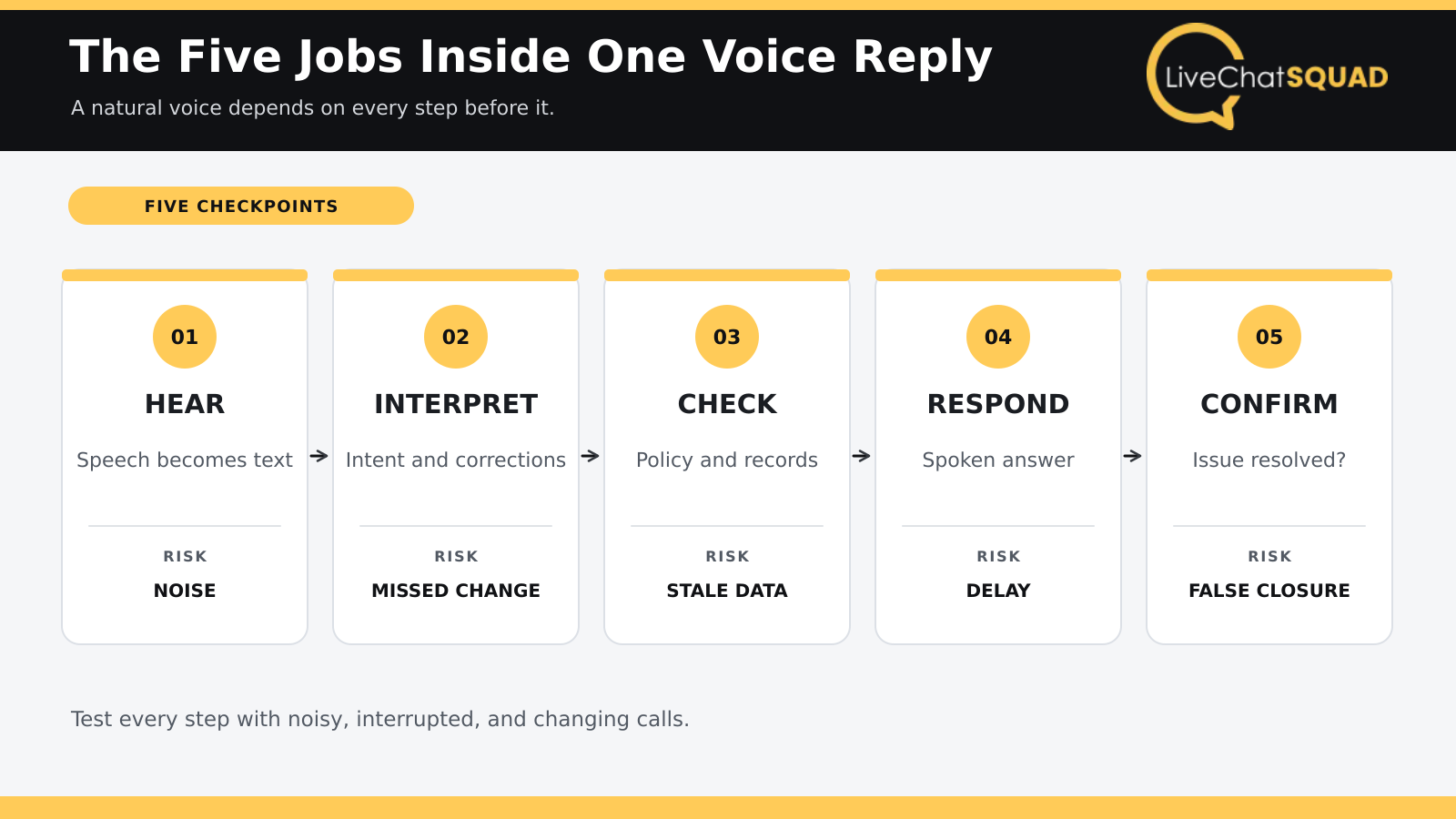
A voice agent turns speech into text, then works out what the caller wants and what parts of the conversation mean. It checks approved information or connected systems before forming an answer and speaking it aloud.
From Spoken Question to Spoken Answer
Each step depends on the one before it. If background noise turns ‘I was charged twice’ into ‘I changed my card’, the agent may search for the wrong issue and deliver an answer to a question nobody asked. A fluent reply can fail when its starting point is wrong.
What Makes the Conversation Feel Natural
Natural conversation depends on more than a voice. Callers need clear words, a pace they can follow, and pauses long enough to respond. The agent should stop when someone interrupts, distinguish a correction from a ‘yeah’, and remember the corrected detail in its reply.
These details matter when comparing AI customer service solutions: a smooth greeting means little if the system talks over a caller or keeps using the wrong account number after being corrected.
Why an Angry Call Puts a Polished Voice to the Test
An attentive, lifelike voice suggests the caller can explain the whole problem. If the agent replies with a script after hearing “I’ve already paid,” the mismatch feels personal. The caller may assume the business has heard the complaint and decided not to help.
A Natural Voice Raises Expectations
A natural voice can make a conversation easier, but it also raises the standard for what happens after the greeting. Its answer needs to match the complaint.
Emotionally Fluent Language Can Still Feel Wrong
An acknowledgment works best when it leads somewhere:
- ‘I’m sorry you’ve explained this twice. Let me check the charge’ names the issue and offers action.
- ‘I know exactly how you feel’ claims an understanding the system can’t genuinely have.
A 2026 study of text chatbots found that humanlike design can intensify anger when the interaction fails. University of South Florida researchers found that mirroring negative emotions can backfire in text chat. These findings offer design cautions, not measured voice-call outcomes.
A Failed Process Becomes Part of the Complaint
Consider this illustrative call: a customer says a technician never arrived and asks for a refund. The agent apologizes for the delay, asks for the appointment number again, then says it can’t access refunds or reach a manager.
The missed appointment was the original problem; repeated questions and a blocked handoff now give the customer another reason to complain. Trust depends on a useful next step after a failed first response.
The Breakpoints That Turn One Bad Call Into a Brand Problem
A pleasant voice can hide a fragile process. Deploying AI handling angry customers before testing noisy calls, corrections, missing records, and system delays puts the business at risk of giving a polished answer to the wrong problem.
| What breaks | What the caller hears | What needs fixing |
| Noise or an unfamiliar accent | The agent repeats the wrong order number or mishears the complaint. | Test varied audio and ask the caller to confirm critical details. |
| An interruption or correction | The agent talks over “No, that’s my other order” and continues with its first answer. | Test turn-taking and update the conversation when a detail changes. |
| Outdated information or missing access | The agent confidently quotes an old policy or can’t check the account. | Maintain approved information and set limits on unsupported answers. |
| Several issues in one call | It addresses the delivery but forgets the incorrect charge. | Track each issue and confirm what remains unresolved. |
| A slow or failed lookup | Silence stretches into another prompt or the same reply repeats. | Set a timeout and offer a clear route to a person. |
The Moment the Error Becomes a Trust Problem
Consider an illustrative call: a customer whose card shows an incorrect charge and whose order hasn’t arrived. The agent finds an old shipping status and says the package is on its way. When the customer asks about the charge, it repeats the delivery update.
The customer corrects it twice, but the answer never changes.
The missing order brought the customer to the phone. The repeated, irrelevant answer makes them question whether the business understands either issue. If they can’t reach someone who can check the payment, they may hang up, complain publicly, or try another channel.
In McKinsey’s analysis of voice-agent deployments, documented failures include missed intent, repetitive replies, weak context retention, and poor recovery on calls with several issues. The example above is illustrative; the operational risk is documented.
So, Why the Agent Doesn’t Hand Over the Call?
The Trigger Might Never Be Set
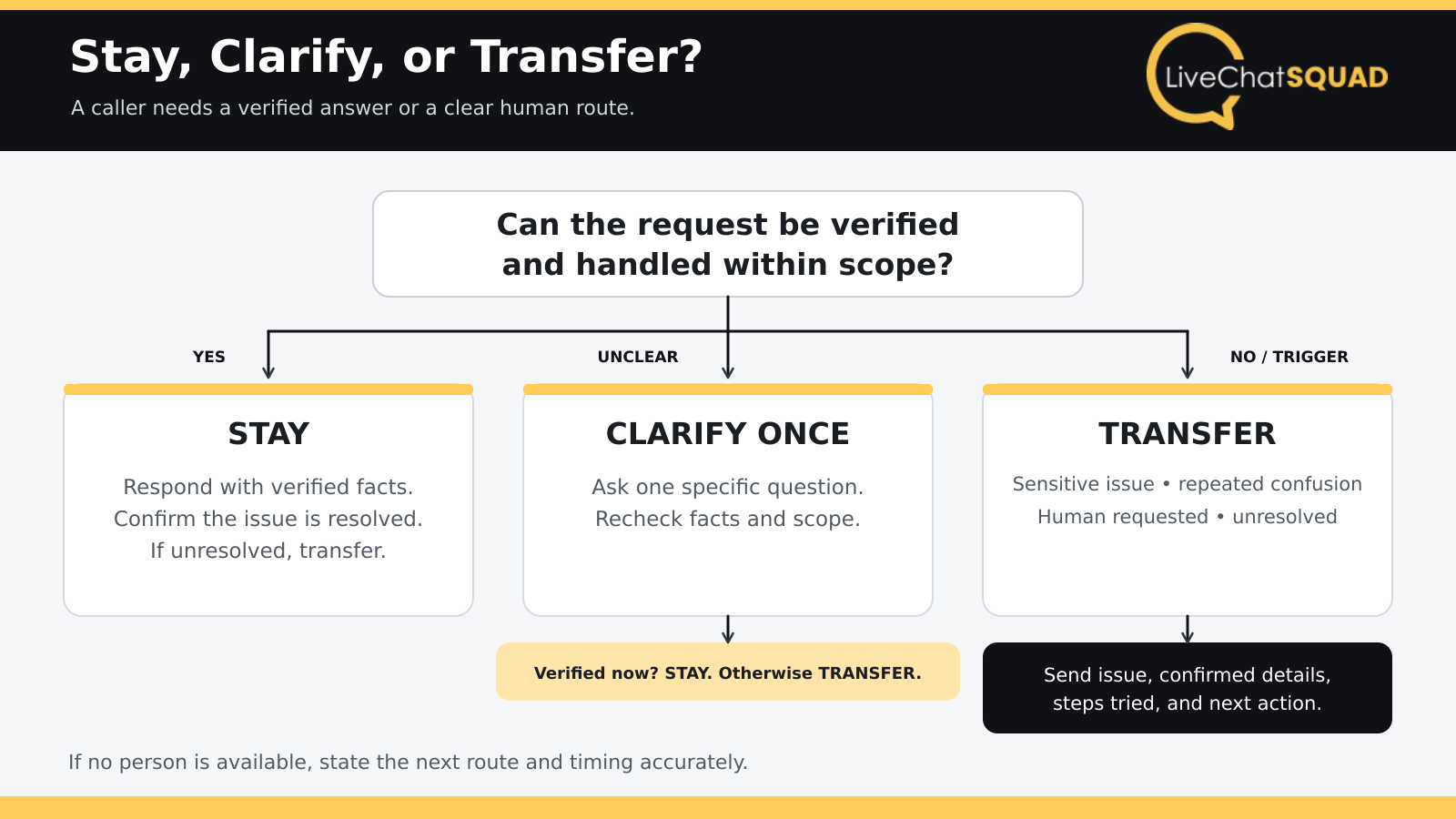
A caller’s tone can signal frustration, but it can’t tell the agent whether it has the authority or information to help.
Escalation rules should also respond when:
- The caller asks for a person or repeats a correction.
- The agent can’t confidently identify the request or access a needed record.
- The issue is sensitive or requires an action the agent isn’t allowed to take.
A calm caller reporting an urgent error may need a human sooner than an angry caller asking a straightforward question.
A Transfer Can Fail Even After the Agent Offers One
‘Let me connect you’ only helps if someone can receive the call. The system needs to know which team handles the issue, when that team is available, and what to say when an immediate transfer isn’t possible.
It also needs to pass along a useful call summary: what happened, what the caller has already confirmed, and what remains unresolved. Without that context, the person taking over may ask every question again.
Teams can miss these failures when they judge success mainly by how many calls the AI keeps. McKinsey recommends measuring resolution and repeat calls alongside the effect of handoffs.
How Teams Prepare Voice Agents for Difficult Conversations
Start with the information it’s permitted to use: current policies, approved answers, and connected order or booking records where appropriate. Decide who updates each source when a price, process, or service area changes. Otherwise, a once-correct answer can quietly become wrong.
Give the Agent Reliable Information and Clear Authority
Set action limits just as clearly.
Can the agent check a charge, submit a request, or book an appointment? Which exceptions require staff approval? It shouldn’t promise a refund, callback time, or outcome the business hasn’t authorized.
Design Recovery Into the Conversation
Practice the calls that refuse to follow a neat script: someone interrupts, corrects an account number, changes the question, or brings up two problems at once. The agent needs a way to acknowledge uncertainty, check the corrected detail, and return to anything still unresolved.
For example: ‘I heard you say the charge appears twice, and your order hasn’t arrived. I can check the order status first. I’ll pass the charge question to someone with access to your payment record’.
That response identifies both issues and states a next action without pretending to solve either one.
Train the Handoff as Carefully as the Greeting
Decide which signals trigger a transfer, which team receives it, and what happens outside that team’s hours. A useful handoff includes the caller’s request, confirmed details, steps already attempted, and the reason the agent stopped.
If nobody’s available immediately, give an accurate follow-up route rather than implying someone is waiting on the line.
Also Read: 4 Reasons AI Can Never Replace Human Customer Support.
Do Remember to Review Failures After Launch
Assign someone to review difficult calls, correct outdated information, and retest the revised response or routing rule. Check whether callers reach a useful outcome after the change; a smoother-sounding reply alone isn’t proof that the problem is fixed.
Test the Difficult Calls Before You Scale
A successful demo tells you little about a call from a noisy street or a customer who changes their request halfway through.
Build a Test Set From Real Call Patterns
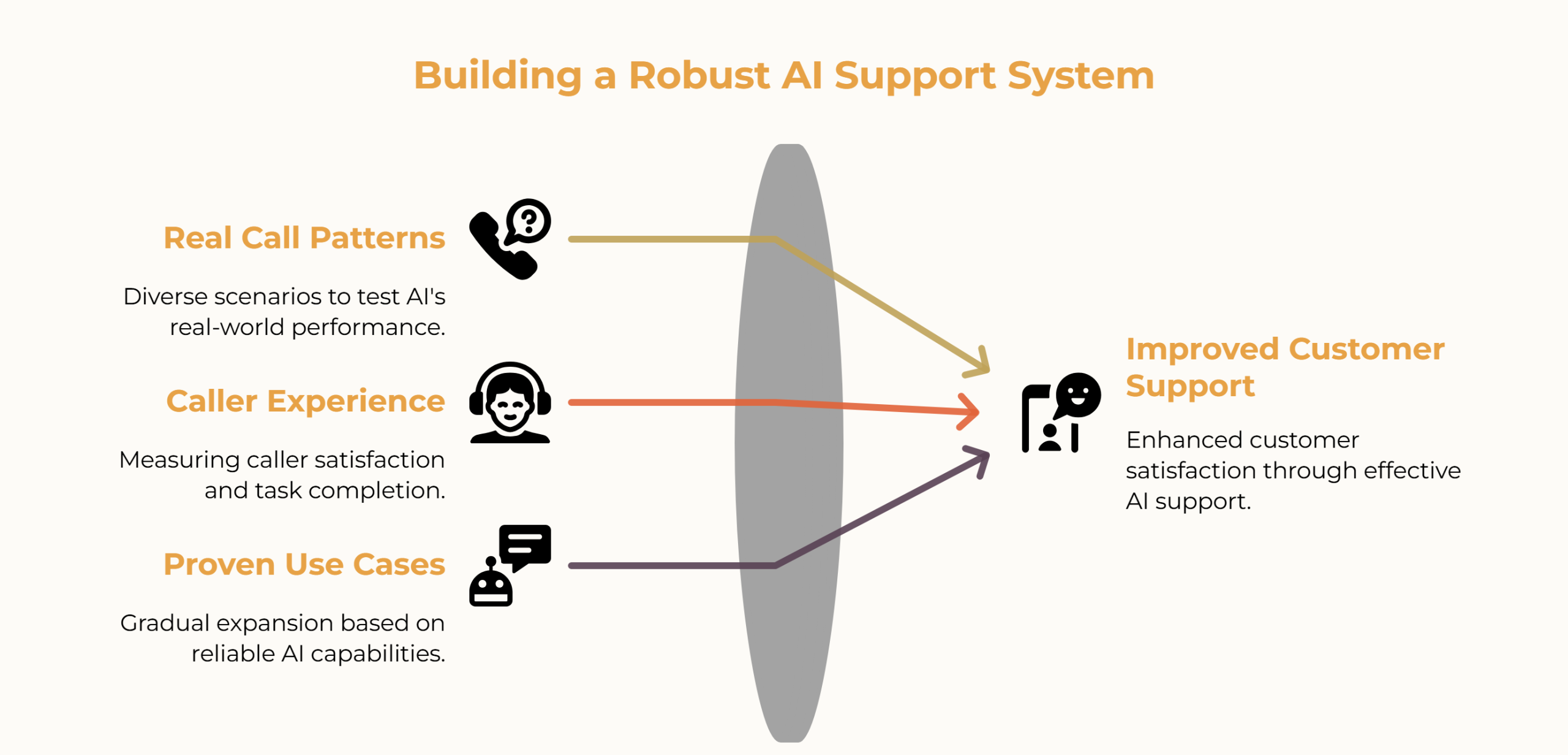
Test accents, interruptions, corrected details, and two issues raised together. Include a calm caller with an urgent problem, an angry caller with a simple request, and someone who asks directly for a person.
Give each scenario an expected outcome. The agent might resolve it, ask one useful question, or transfer it. This makes missed and unnecessary escalations easier to spot.
Measure the Outcome the Caller Experiences
A practical scorecard for conversational AI for customer support should record whether the agent:
- Understood the request and used verified information.
- Completed the permitted action or transferred at the right point.
- Passed confirmed details to the next person without making the caller start over.
Then check repeat calls and caller satisfaction. A call that ends with the AI isn’t necessarily resolved; a transfer isn’t necessarily a failure. Review the recording and the eventual outcome together, especially when the agent sounded convincing but took no useful action.
Expand by Proven Use Case
Begin with bounded requests the agent can complete reliably, such as checking an available order status. For online stores, compare those test calls with the questions handled through e-commerce chat support so information stays consistent across channels.
Add harder requests only when testing and live monitoring show that callers receive accurate answers and a dependable way out when the agent reaches its limit.
Keep Human Help Within Reach Across Channels
After a difficult call, the next useful step may be a person on the phone, a website chat, or a follow-up from the right team. An appointment-based business might use service provider live chat support for website inquiries while its staff handle decisions that need their authority.
| Request | Where automation helps | Where a person steps in |
| Routine information | Gives a verified answer or checks an available status. | Handles an exception the system can’t confirm. |
| Uncertain or changing facts | Collects details and identifies what needs checking. | Verifies current information before making a commitment. |
| Disputes or sensitive decisions | Records the issue and routes it promptly. | Reviews the circumstances, exercises authorized judgment, and owns the response. |
Make the Next Conversation Count
LiveChatSquad offers human staffed website chat and live call answering. Its 24/7 live chat support services can give visitors a way to ask questions outside normal business hours, while call answering provides another human contact route. These are distinct services; any movement between channels needs a process the business has agreed on.
Our guide to humanizing live chat conversations focuses on listening, context, and replies that address the visitor’s actual question. Those habits matter whenever a person picks up an unresolved issue.
One reason AI can never replace humans entirely in sensitive interactions is that someone must assess exceptions, exercise authorized judgment, and take responsibility for the next step. The best route gives that person the details already gathered so the customer doesn’t have to begin again.
Give Frustrated Customers a Better Next Step
Before another caller has to explain the same problem twice, look at where your calls stall. Which requests can your team resolve? Which need someone with account access or authority to act? And how easily can a customer reach that person?
A plan for AI handling angry customers works best when those answers are clear. LiveChatSquad offers human staffed website chat and live call answering to help businesses stay reachable across channels.
Tell us about your hours, the inquiries you receive, and the coverage you need. Get started with a conversation or call (888) 504-2627 to discuss a walkthrough.
Frequently Asked Questions
Can you help customers after business hours?
Yes. Our 24/7 outsourced chat agents can respond to website visitors after hours. Tell us which inquiries need your team’s attention so we can discuss a suitable follow-up process.
Can you support both our online store’s chats and calls?
We offer human staffed website chat and live call answering. Tell us how you handle order, delivery, return, and payment questions, and we’ll discuss coverage for each channel.
What do you need from a service business to get started?
We’ll ask about your services, service area, appointment requests, and urgent inquiries. Clear follow-up instructions help our agents pass each request to the right person.
Can our agency offer chat under its own brand?
Yes. Our digital agency live chat support includes a white-label option. We can discuss your branding, chat scripts, lead criteria, reporting, and how inquiries reach your clients.
Can you help route property inquiries?
Our real estate live chat support can gather visitor details and pass inquiries to your team. Tell us how you want listing questions and viewing requests handled.
Will you receive summaries from our AI voice agent?
That depends on your voice system and its integrations. We can discuss what information your team needs, but you should confirm voice-call summaries and transfers with that provider.
Can our current team stay involved?
Absolutely. You can define which inquiries our agents handle and which need your staff. We’ll discuss coverage hours and follow-up responsibilities before service begins.
What should we share when requesting a plan?
Tell us your preferred channels, hours, common inquiries, and who handles sensitive cases. We’ll use those details to discuss a plan that fits your business.