



It’s 9:47 p.m. A potential customer reaches your website, checks your service area, and asks whether you have an appointment this week. Silence follows. They return to Google, open another result, and continue the conversation with a business that answers.
Speed, however, means more than sending an automatic greeting before anyone is ready to help. The fastest dependable response method uses live chat support services to engage visitors immediately, answer approved questions, and route complex inquiries without making the visitor start again.
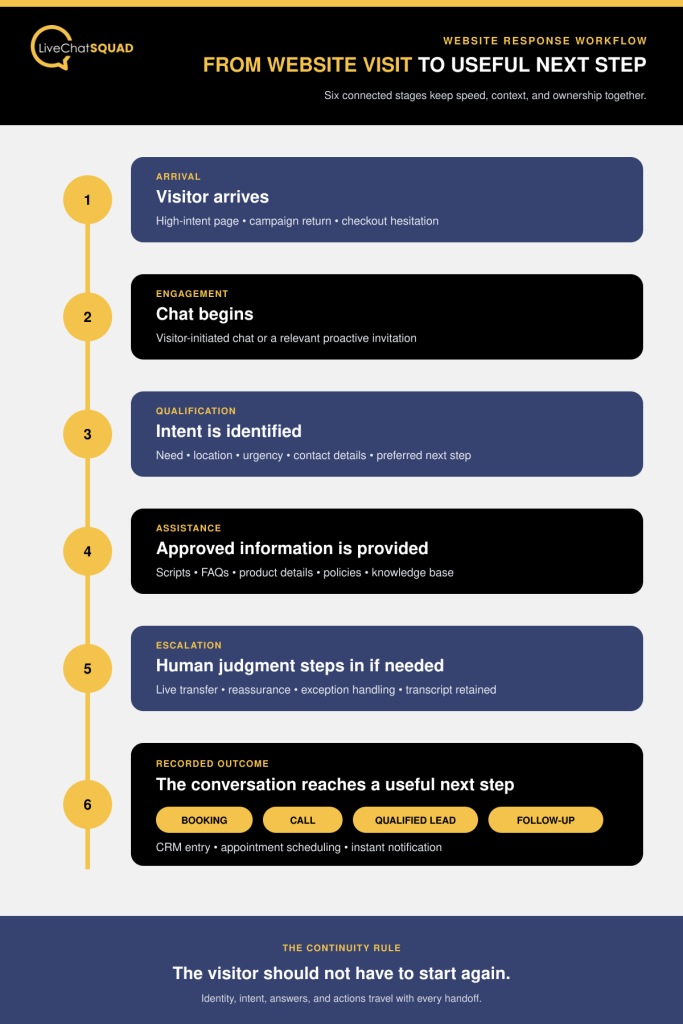
A responsive system notices the inquiry, begins a useful exchange, preserves the details already shared, and guides the visitor toward an answer, appointment, transfer, or clearly defined follow-up.
No single widget creates that experience by itself. Response speed depends on the channel you offer, the hours you cover, the information your team can access, and the rules governing automation, qualification, routing, and escalation.
Building those elements together helps you reply quickly without sacrificing accuracy, context, or human judgment.
Website Response Time Matters A Lot While Intent Is Active
Live chat is generally the fastest website response channel because it lets visitors get help without leaving the page, checking an inbox, or waiting for a return call. Unlike a submitted form or a phone queue, real-time customer support creates a two-way conversation during the same browsing session.
Consider a homeowner checking whether a contractor serves their neighborhood. An agent can confirm the service area, collect project details, and help arrange a consultation before the homeowner closes the page.
Speed becomes important when someone is comparing providers, checking availability, trying to book, resolving purchase hesitation, or viewing a high-intent service or product page. A quick answer can’t guarantee the sale, but silence gives an interested visitor little reason to remain.
What Makes a Fast Website Response Useful?
A useful website response acknowledges the visitor, addresses the immediate question, and moves the conversation toward an appropriate next step.
- Acknowledgement: The visitor knows their message reached someone.
- Assistance: They receive information related to what they asked.
- Progress: The exchange reaches a booking, recommendation, qualification decision, live transfer, captured lead, or documented follow-up.
An instant ‘Someone will be with you shortly’ message can reduce uncertainty, but it isn’t an answer. The real value of Live chat support services appears when the first meaningful response reduces customer effort rather than adding another waiting stage.
Accuracy matters, too. A quick but incorrect reply can create extra work, weaken trust, and leave the visitor less confident than before.
The commercial stakes extend beyond one abandoned inquiry. PwC’s 2025 Customer Experience Survey found that 29% of consumers had stopped using or buying from a brand because of poor customer experience online or in person.
How Live Chat Support Services Create a Faster Response
Staffed chat shortens website response time by keeping the exchange on the page. An agent can identify the visitor’s need, provide approved information, and route the next step while interest remains active, without depending on a form submission or an inbox someone checks later.
Proactive Chat Starts at the Right Moment
A visitor may open the chat themselves, or the site may offer a carefully timed invitation. Page-specific greetings and behavior-based prompts can respond to time spent on pricing, repeated visits, checkout hesitation, a high-intent service page, or a return from an advertising campaign.
After-hours coverage keeps the option available when the internal team is away. Immediate pop-ups on every page can feel intrusive; relevance should determine the timing.
Qualification Reveals the Visitor’s Real Need
Qualifying should resemble helpful conversation, not an interrogation. An agent can establish the requested service, location eligibility, urgency, preferences, appointment availability, contact details, and preferred next step through natural questions.
A homeowner, for example, could confirm coverage, describe a repair, provide their number, and request a call within one exchange. Agreed criteria help the business receive leads it can realistically serve.
Approved Information Prevents Guesswork
Speed also depends on what agents are permitted to say. Approved scripts, FAQs, service and product details, pricing language, policies, current offers, and knowledge resources support accurate answers.
Clear boundaries identify questions requiring escalation.
Businesses considering 24/7 staffed chat solutions can prepare these materials before launch. Ecommerce teams can also explore the company’s AI customer support ecommerce guide for a channel-specific look at response automation. Staffed human service and AI-enabled options should remain clearly distinguished.
Also Read: How AI Improves Response Time in Ecommerce Customer Support
Context Travels With the Handoff
A productive handoff can schedule an appointment, initiate a live call, route the inquiry, create a CRM record, send an email or SMS notification, store the transcript, or establish a follow-up time.
Each next step should carry the visitor’s name, location, request, and previous answers. Repeating those details after every transfer wastes the speed gained at the beginning and makes the support process feel disconnected.
Continuity turns a reply into genuine progress.
Which Customer Support Channel Responds Fastest?
Live chat has the clearest speed advantage for someone already browsing your website because the conversation begins without changing channels. A website live chat service can answer a question during the same session, while contact forms and email rely on later follow-up.
Phone and AI may respond just as quickly in the right circumstances.
| Channel | Initial response | Best suited to | Main limitation |
| Contact form | Usually delayed | Detailed, non-urgent inquiries | The visitor may leave before follow-up |
| Asynchronous | Documents and longer explanations | Requires inbox switching and waiting | |
| Phone | Immediate if answered | Urgent or complicated conversations | Missed calls, queues, and limited coverage |
| AI-only chat | Potentially instant | Routine, clearly defined questions | May misread nuance or block human access |
| Staffed live chat | Near-immediate during coverage | Questions, qualification, and guided next steps | Requires trained coverage and current information |
| AI-assisted human chat | Immediate assistance with judgment available | Higher volumes and varied inquiry types | Requires deliberate integration and handoff rules |
Speed Alone Doesn’t Determine Suitability
Phone works for urgent or complicated conversations, while email remains useful for documents and detailed explanations. AI can resolve predictable questions quickly, and a trained agent can adapt when a request becomes ambiguous, emotional, or important.
Hybrid support can combine automation with human judgment, provided the handoff carries context forward. A correct escalation that takes longer may protect trust better than an instant answer that is inaccurate, incomplete, or impossible to act on.
AI Can Accelerate Support Without Replacing Human Judgment
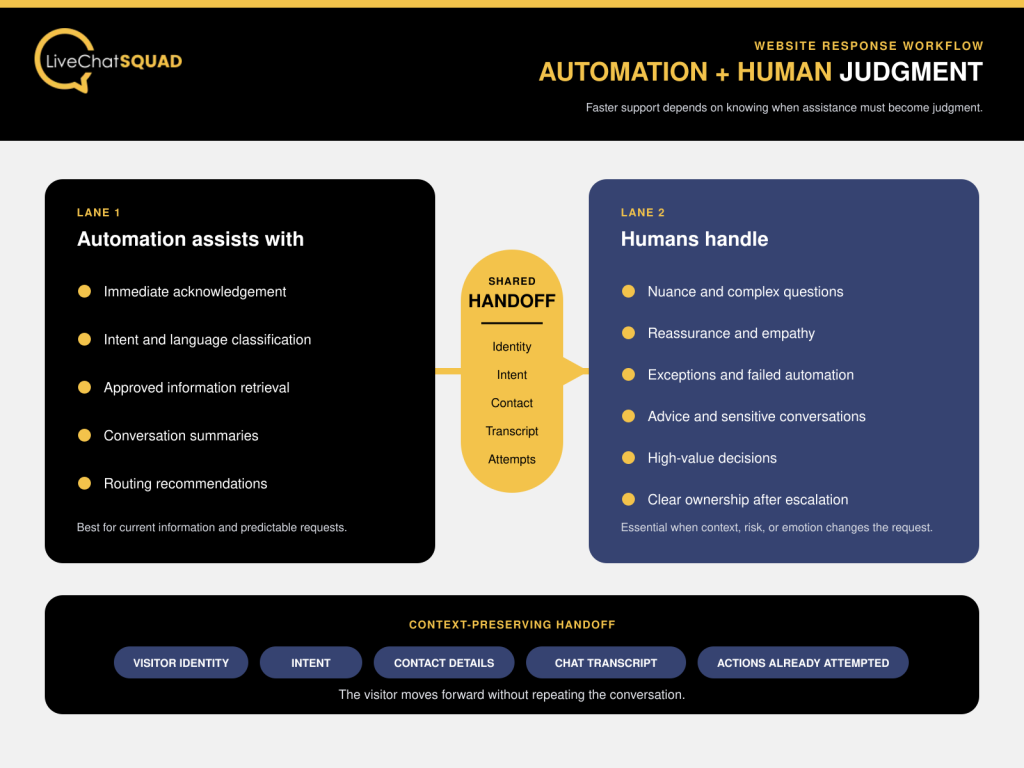
AI can accelerate customer-support work, but it shouldn’t independently handle every visitor, question, or risk level. It reduces repetitive effort while preserving access to human assistance.
Automation Handles Repetitive Tasks Quickly
Automation performs best when information is current and the visitor’s request is predictable. Practical uses include:
- Acknowledging conversations and collecting routine details
- Detecting language or intent, then recommending basic routing
- Answering FAQs or sharing simple order and appointment information
- Suggesting agent replies and summarizing conversations
These functions shorten early response stages, but unclear questions need human help.
Human Agents Handle Nuance and Risk
The question of AI replacing human assistance in service support becomes easier to answer when businesses examine individual tasks instead of treating service as one uniform activity.
People remain essential when visitors are frustrated, requests are ambiguous, personal information is sensitive, or a conversation involves high-value sales, policy exceptions, regulated matters, negotiation, repeated automation failure, reassurance, or judgment.
A randomized field experiment involving 138 agents and over 250,000 conversations found that AI-assisted agents responded 22% faster and produced messages with greater empathy, information, and solution quality.
Harvard Business School’s 2026 analysis also noted that exceptionally fast AI-assisted replies after chatbot failure could reduce sentiment because visitors believed they were still dealing with automation.
Pew Research Center’s findings on public AI concerns reinforce the need for human access, citing worries about inaccurate information and reduced human connection.
Also Read: Why AI Can Never Replace Human Customer Support
A Clean Handoff Protects the Visitor Experience
Escalation should provide visible access to a person, defined triggers, transferred transcripts and data, honest timing expectations, and clear ownership. Visitors shouldn’t have to repeat answers automation already collected once.
Build the Response System Before the Question Arrives
Businesses respond faster when information, routing rules, coverage schedules, escalation contacts, and communication boundaries are prepared in advance. Preparation lets an agent act confidently instead of searching for answers while the conversation stalls.
Give Agents a Reliable Source of Truth
Build an approved knowledge source covering products, services, service areas, availability, pricing language, promotions, shipping, returns, cancellations, booking instructions, common objections, and emergency boundaries. It should also identify claims agents can’t make without approval.
Outdated information can make a fast answer worse than a slower, accurate one. An expired promotion or incorrect service-area list, for example, may create a lead the business can’t honor.
Map Routing and Escalation Clearly
Document who receives sales, support, and billing inquiries; which issues need an immediate transfer; and which requests can become appointments. The escalation matrix should explain what happens when the responsible person is unavailable, which details travel with the handoff, and what follow-up time agents may promise.
Include regional offices, service eligibility, appointment availability, and separate paths for urgent and non-urgent needs.
Cover After-Hours Inquiries and Traffic Spikes
Coverage planning should account for:
- Evenings, weekends, lunch periods, and staff meetings
- Multiple time zones and seasonal demand
- Product launches and paid-campaign surges
- Overflow from an internal team
Businesses comparing chat service providers should examine whether a service-provider solution can cover gaps without creating vague availability promises. An ‘online’ chat box tells visitors that somebody can respond.
Review Conversations for Knowledge Gaps
Everything from recurring questions, missing information, abandoned chats, visitor objections, poor escalations, agent tone, script accuracy, and qualification quality needs a thorough review. Those findings should guide knowledge-base updates and coaching.
NIST’s Generative AI Risk Management Profile also discusses human review, tracking, documentation, monitoring, and management oversight for AI systems. It offers risk-management guidance, not legal or regulatory compliance advice.
Which Live Chat Metrics Reflect the Real Response Experience?
A two-second greeting looks impressive on a dashboard, but not if the visitor waits ten minutes for an answer or leaves without help. Measure the experience: how quickly someone receives meaningful assistance and whether the conversation produces an outcome.
Useful metrics include:
- Median first-response and first meaningful-response times
- Resolution and human-transfer times
- Chat abandonment and customer satisfaction
- Qualified-lead, booking, and live call-connection rates
- Follow-up completion and unanswered questions
- Results by page, campaign, hour, and inquiry type
Averages can mislead by hiding long waits during evenings, weekends, or campaign spikes. Segment sales, support, spam, repeat visitors, out-of-area inquiries, and qualified leads so unlike conversations don’t distort the story.
Transcript reviews show what numbers miss: what confused people, where they became frustrated, and why they left. Teams exploring the revenue connection can review Live Chat Services to Boost Leads for practical insight.
A Qualified Conversation Still Needs an Owner
A qualified conversation has value only if someone remains responsible for what happens next. The visitor may have shared their budget, location, appointment time, and contact details. Letting that context sit untouched turns a fast response into a delay.
Give every outcome a named owner:
- Receive: The right person gets the transcript, lead details, and requested next step.
- Respond: They follow the promised timeline, confirm the appointment, return the call, or clarify what is still needed.
- Record: The CRM reflects the status, next action, and person responsible.
- Recover: Missed calls, failed transfers, and unanswered notifications return to a visible follow-up queue.
Ownership should continue until the visitor reaches the agreed destination not end when the chat window closes. This keeps qualified inquiries from becoming forgotten notifications and makes reporting more honest.
The business can see not only which conversations began well, but which opportunities received the follow-through needed to move forward.
Where Live Chat Fits After the Visitor’s First Click
Marketing, SEO, paid advertising, social media, and content can bring visitors to your website. Traffic alone can’t answer a pricing question, confirm availability, ease hesitation, or arrange the next step. A direct conversation helps visitors share details and move toward an appointment, call, or qualified inquiry.
LiveChatSquad helps create opportunities through trained human agents and 24/7/365 coverage. Its service includes proactive engagement, customized scripts, lead qualification, appointment capture, live call connections, CRM and app integrations, transcripts, and reporting. Pay-per-qualified-lead pricing connects cost with useful conversations rather than chat volume.
Digital agencies can offer live chat services for digital agencies across client websites without recruiting, training, and scheduling a 24/7 team. White-labelled options preserve the agency relationship, while a trial with no credit card or long-term contract lowers the barrier to testing the experience. A trial can’t guarantee conversion, but it reveals how reliably conversations reach the next step.
Turn Existing Website Traffic Into Actionable Conversations
Your next high-intent visitor may arrive after your team has gone home. Since 2011, LiveChatSquad has provided 24/7 human chat coverage and, according to the company, supported over 2,000 U.S. businesses and generated more than 300,000 leads.
Share your website, common questions, busiest enquiry periods, response process, after-hours gaps, qualification requirements, and current CRM or calendar. Tell us whether each qualified conversation should become an appointment, live transfer, or lead notification.
Explore our live chat support services through a demonstration, consultation, or trial, no credit card or long-term contract advertised, or chat with the team at (888) 504-2627 to begin.
Frequently Asked Questions
How Quickly Can Live Chat Be Added to an Existing Website?
A basic widget can be installed quickly, but timing also depends on approved scripts, routing, integrations, agent preparation, and testing. Reliable coverage starts only when agents have the information and processes needed to respond.
Can Live Agents Cover Only Evenings and Weekends?
Yes. Coverage can be full-time, after-hours, weekends only, campaign-specific, or overflow for an internal team. The schedule should match inquiry volume, forwarding rules, internal availability, and the response times promised to visitors.
Can Chat Agents Follow Our Scripts and Brand Voice?
Yes. Provide FAQs, tone guidance, approved terminology, qualification questions, current offers, service areas, and escalation rules. Regular updates and transcript reviews help agents remain accurate, natural, and aligned with the brand.
What Happens If an Agent Can’t Answer a Visitor’s Question?
The agent should acknowledge the limit, collect relevant details, preserve the transcript, and escalate the inquiry with an honest follow-up expectation. A careful handoff protects trust better than an immediate but invented answer.
Can Chat Conversations Connect With Our CRM or Calendar?
Possibly, but compatibility should be confirmed before setup. Supported connections may create contact records, schedule appointments, preserve transcripts, send lead notifications, route inquiries, or trigger follow-up workflows across the business.
How Does Pay-Per-Qualified-Lead Pricing Work?
The business and provider agree on qualification criteria before billing begins. Confirm which inquiries count, how spam, repeat visitors, and out-of-area leads are treated, and how rejections, reporting, and invoicing work.
Can Digital Agencies Offer the Service Under Their Own Brand?
Yes. White-labelled options may include branded widgets, dashboards, notifications, and client reports. Confirm client ownership, billing, integration support, account management, and how visible the delivery partner remains before presenting the service.
What Should You Test Before Committing to a Provider?
Test response speed, accuracy, brand alignment, escalation, qualification, integrations, reporting, and after-hours performance. Review real transcripts alongside billing definitions, support access, trial conditions, and cancellation terms before choosing a provider.